The book · Coming early 2027
How Extractors Broke Meritocracy, and How Builders Can Take Capitalism Back
Something has gone badly wrong with the economic system we built. Not because of a secret room full of villains, but because millions of people responded rationally to the incentives in front of them, and the system slowly learned to serve itself. This book is about seeing that machine clearly, and building something better.
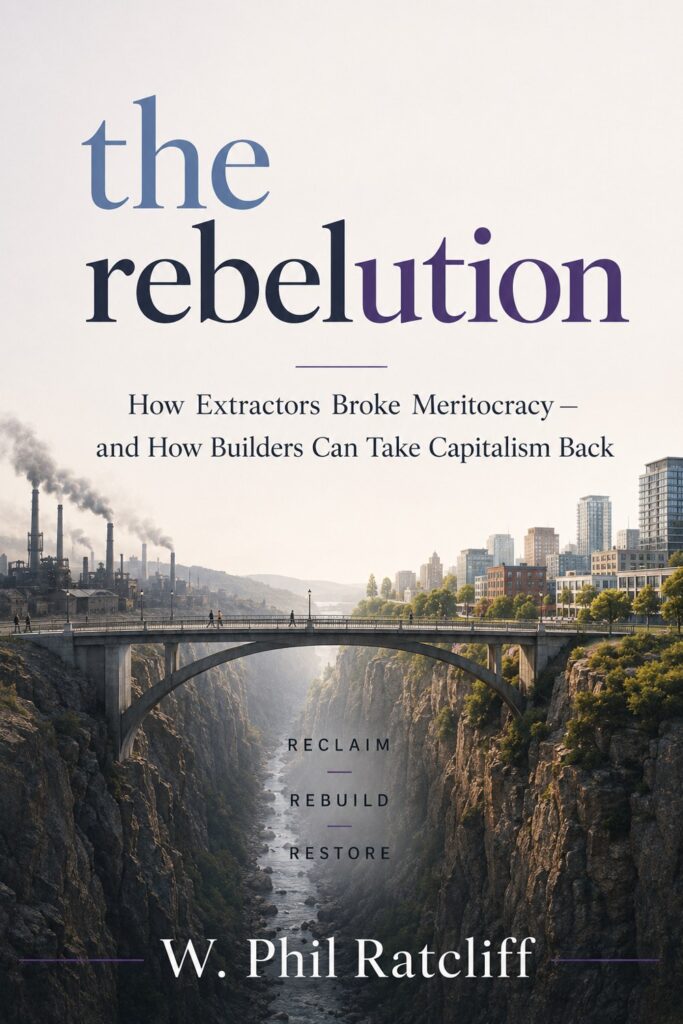
Cover draft. Final art coming.
Why I wrote it
There are thousands of good books on saving, investing, taxes and getting out of debt. I've read a lot of them. This one is different: part financial manifesto, part leadership manifesto, and the most personal thing I've written.
It comes from decades of studying history, serving in the military, working inside the financial industry, building companies, advising families and business owners, sitting across from politicians and executives, raising kids, making mistakes and changing my mind.
I've seen the system from both sides of the table. From inside the institutions, and from across the desk from the families those institutions are supposed to serve. The more I saw, the more the question changed, from how do I build a better financial firm, to what's wrong with the system itself, and what can ordinary people actually do about it?
Human systems are not forces of nature. We created them. Which means we can change them.
From the introduction
I own businesses. I invest. I want entrepreneurs to win big. I also think capitalism works best when opportunity is real, people have some basic security, and the winners can't rewrite the rules for everyone else. Those ideas aren't opposites.
A few of the big ideas
Here's a peek at the vocabulary. The book is where they all click together.
Part I
Before it says anything about what's broken, the book starts with what's right with us. Humans build. We've just been trained to think of ourselves as consumers.
Part II
There's a difference between creating new value and capturing value somebody else created. A lot of modern wealth comes from the second one.
Part II
Nobody designed it. Finance, law, technology, politics and concentrated capital just evolved into a system that's very good at protecting itself.
Part III
Most Americans aren't really defending laissez-faire capitalism. They're defending a fair shot. Those aren't the same thing anymore.
Part III
The real divide isn't rich versus poor. It's who adds value and who takes it, and most of us are somewhere in between.
Part IV
Why smart, responsible people stay confused inside systems even the experts struggle to understand, and who benefits from that confusion.
Part V
Small cuts on your money, time and attention, at every step of life. One at a time they look harmless. Over a lifetime they're your freedom.
Part VI
Not anti-capitalist. Anti-extraction. The best of markets and ownership, combined with real opportunity and shared security.
Parts VII and VIII
An individual awakening and a collective effort: build yourself, strengthen the people closest to you, help others build, then help fix the system.
The arc
01
Remember who we are
02
See what went wrong
03
Understand the machine
04
Decide what to build
05
Build personally
06
Build together
And it's practical, too: a Builder's Financial Operating System, the rebel Roadmap, and the questions to ask so you don't hire another extractor to guide you.
Who it's for
You don't need an economics degree. I wanted it readable for someone who hates finance, and still worth arguing about for an economist or a policymaker.
A 25-year-old getting out of debt
A 70-year-old with a few million
Entrepreneurs
Teachers
Business owners
Advisors
People losing hope in the future
You were not born merely to consume what someone else built.
From Chapter 1, We Are Builders
Take the arguments with a grain of salt. Challenge them. Tell me where I'm wrong. The last thing I want is another ideology people have to swallow whole. The point is to think.
the rebelution is coming in early 2027. Get on the list and I'll let you know the moment it's out, plus early chapters and behind-the-scenes notes as it comes together.